
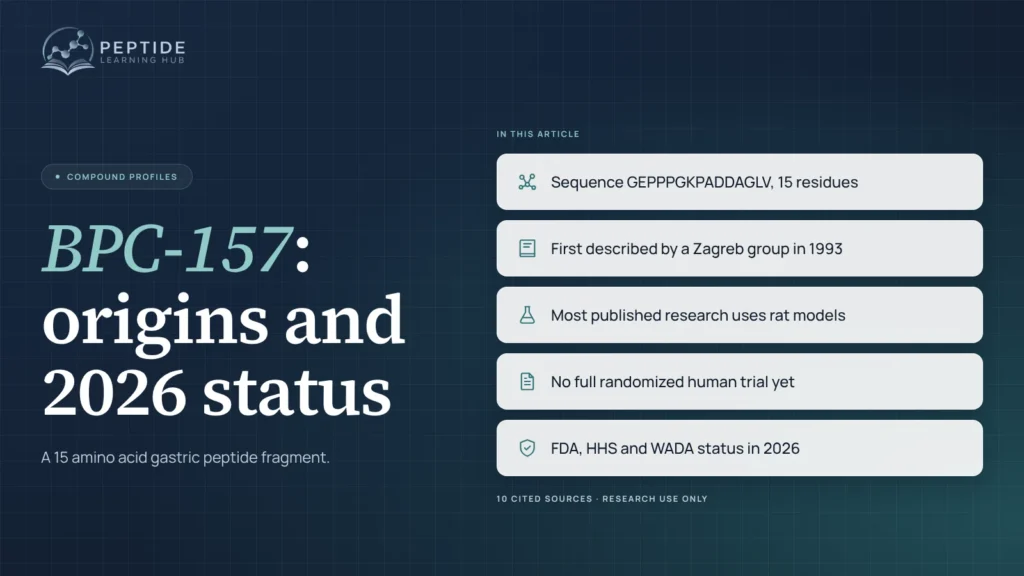
BPC-157 is a synthetic 15 amino acid peptide, GEPPPGKPADDAGLV, based on part of a larger protein first isolated from human gastric juice by a research group in Zagreb. Almost all published research on it comes from rats and other animal models. It is not an FDA approved drug.
This profile covers BPC-157 from the laboratory side: what the molecule is, where it came from, which research models have studied it, what human data exist and where its regulatory status stood in November 2026. It sits in the research topics index under compound profiles, which separate what a study measured from what it is often taken to mean.
It covers published research only and does not describe any use of BPC-157 in people or animals.
What BPC-157 is, chemically
BPC-157 is a pentadecapeptide, a chain of 15 amino acids: glycine, glutamic acid, proline, proline, proline, glycine, lysine, proline, alanine, aspartic acid, aspartic acid, alanine, glycine, leucine and valine. In one-letter code that is GEPPPGKPADDAGLV. The free peptide has the formula C62H98N16O22 and an average molecular weight of about 1419.5 g/mol, the figure the original research group gives as M.W. 1419.
The Zagreb group has repeatedly described BPC-157 as stable in human gastric juice for more than 24 hours, and contrasts this with growth factors such as epidermal growth factor, which they report break down there within minutes. That stability claim comes from the same group’s in vitro work, and reviews treat it as a reported property rather than an independently confirmed one. It is one reason the molecule drew interest as a research tool for gut models.
Research material is usually supplied as a salt. The acetate form is the most common in the literature and is the form named in 2026 US compounding documents. An arginate form, the same sequence paired with L-arginine, comes from later patent work on stability. The salt changes the weight of what is in the vial, so a certificate should say which form it describes.
Pentadecapeptide
A peptide made of 15 amino acids. BPC-157 is one, written GEPPPGKPADDAGLV.
Salt form
The counterion paired with a peptide, such as acetate or arginate. It changes the mass but not the sequence.
Preclinical
Research done in cells or animals, before any testing in people.
WADA S0
The anti-doping class for substances with no current approval for human therapeutic use.
Terms such as salt form, preclinical and sequence notation are defined in plain language across the article library.
Where BPC-157 came from
The name stands for body protection compound. In a 1993 paper in the Journal of Physiology (Paris), Sikiric and colleagues at the University of Zagreb described a gastric juice protein of about 40,000 daltons, which they named BPC, and a 15 amino acid fragment of it, BPC 157, that they considered essential for its activity. The same group has produced most of the research published since.
The peptide was later developed by the Croatian company Pliva for inflammatory bowel disease under the codes PL 14736, PL-10 and PLD-116. It has also been called bepecin. These names all refer to the same 15 amino acid sequence, which is why older papers can be hard to find under a single search term.
Before using any BPC-157 finding, check what was studied: rats, mice, cultured cells or people, and which salt form. Secondary sources often drop the model and present a rat result as a general fact.
What the research has examined
Most published BPC-157 work is in rats, often from the Zagreb group, across gastrointestinal, liver, tendon, ligament, muscle, bone and nerve injury models. Two examples from orthopedic models show the typical design.
- Rat Achilles tendon. In a 2003 study, Staresinic and colleagues transected the Achilles tendon in rats and reported better biomechanical, functional and microscopic healing measures in treated animals than in controls over 14 days. They also reported effects on cultured rat tendon cells.
- Rat muscle crush. A 2008 study by Novinscak and colleagues reported improved healing measures in a rat gastrocnemius crush injury model.
The weight of this evidence is narrower than its volume suggests. A 2025 systematic review in HSS Journal by Vasireddi and colleagues screened the orthopedic literature and included 36 studies, of which 35 were preclinical and one was clinical. It found no clinical safety data and noted a half-life of under 30 minutes in animal studies. A 2025 literature and patent review by Józwiak and colleagues reaches a similar view of the gap between animal and human data.
What human data exist
Human evidence is thin and mostly unpublished or uncontrolled.
- Ulcerative colitis trials. Pliva’s PL 14736 was taken into phase II testing for ulcerative colitis. Results appeared only as conference abstracts, not as a full peer-reviewed paper.
- A registered phase I trial. NCT02637284, registered in 2015 to study safety and pharmacokinetics of an oral form in healthy volunteers, has no posted results.
- Small pilot studies. Three uncontrolled pilots published between 2021 and 2025, the largest with 12 participants and the latest with two, all by the same lead author in one journal. The 2025 paper by Lee and Burgess describes itself as a pilot.
No randomized controlled trial of BPC-157 has been published in full. That is the main reason reviews describe it as investigational.
Regulatory status in 2026
BPC-157 is not approved by FDA for any use. Its compounding status changed several times in 2026, and none of those changes made it an approved drug or applied to research use only material.
- FDA Category 2. BPC-157 sat in Category 2 of FDA’s 503A bulk substance categories, for substances that raise significant safety concerns, from 2023 until it was removed on about April 22, 2026, after its nomination was withdrawn.
- Advisory committee. On July 23, 2026, FDA’s Pharmacy Compounding Advisory Committee voted 8 to 6, with one abstention, to recommend BPC-157 for the 503A bulks list, reviewed for ulcerative colitis. The vote is advice to FDA, not a decision.
- HHS policy. An interim HHS enforcement discretion policy, noticed on October 30, 2026, covers BPC-157 acetate compounded by licensed pharmacies and physicians under set conditions. It is not approval.
- Sport. BPC-157 is named as an example in WADA’s S0 class of non-approved substances, which are prohibited at all times.
The wider picture is covered in are research peptides legal in the US. How we decide what a study can support is set out in how we write.
Checking a BPC-157 certificate of analysis
A certificate should show that the vial holds the full 15 amino acid sequence in the stated salt form. These are the points to look for.
- Sequence stated as GEPPPGKPADDAGLV, with the salt form named
- Identity confirmed by mass spectrometry, with an observed mass consistent with about 1419.5 for the free peptide
- Chromatogram showing individual impurity peaks, not only a single purity figure
- Peptide content stated alongside purity, since the salt and water add weight
- A named testing laboratory and a test date
- Lot number on the certificate identical to the lot on the vial label
Matching the lot is covered step by step in lot numbers explained. Why a purity figure alone cannot confirm identity is explained in orthogonal identification.
- BPC-157 is a 15 amino acid peptide, GEPPPGKPADDAGLV, about 1419.5 g/mol
- It is a fragment of a gastric juice protein described by a Zagreb group in 1993
- Nearly all research is in rats; one 2025 review found 35 of 36 studies preclinical
- No randomized human trial has been published in full
- It is not FDA approved; 2026 compounding steps did not change that
Frequently asked questions
BPC-157 is a synthetic peptide of 15 amino acids, GEPPPGKPADDAGLV, based on part of a larger protein that a Zagreb research group isolated from human gastric juice. It has been studied mainly in rats and other animal models. It is not an approved drug and is sold to laboratories as research use only material.
The sequence is Gly-Glu-Pro-Pro-Pro-Gly-Lys-Pro-Ala-Asp-Asp-Ala-Gly-Leu-Val, written GEPPPGKPADDAGLV. The free peptide has the formula C62H98N16O22 and an average molecular weight of about 1419.5 g/mol. Salt forms such as acetate weigh more, so a certificate should state which form it describes, and the expected mass on a mass spectrometry result depends on it.
It was first described in 1993 by Predrag Sikiric and colleagues at the University of Zagreb, in the Journal of Physiology (Paris). They reported a gastric juice protein named BPC and a 15 amino acid fragment, BPC 157, thought essential to its activity. The same group has published most later work.
Mostly rats, with some mouse and cell culture work. Models include stomach and bowel lesions, liver injury, Achilles tendon transection, ligament and muscle injury, bone and nerve damage. A 2025 systematic review of the orthopedic literature found 35 of its 36 included studies were preclinical and one was clinical.
No. BPC-157 is not approved by FDA for any use. A July 2026 advisory committee vote and an October 2026 HHS enforcement discretion policy concern pharmacy compounding only. Neither is a drug approval, and neither applies to research use only material sold to laboratories.
It left FDA’s Category 2 list on about April 22, 2026. On July 23, 2026, FDA’s compounding advisory committee voted 8 to 6 to recommend it for the 503A bulks list. An interim HHS policy from October 2026 covers BPC-157 acetate for licensed compounders. FDA rulemaking has not yet added it.
Yes. BPC-157 falls under WADA’s S0 class of non-approved substances and is named in that class as an example. S0 substances are prohibited at all times, in and out of competition. The 2027 list, in force from January 1, 2027, also adds peptides in general as examples under S0.
Identity is confirmed by mass spectrometry, which should show a mass consistent with about 1419.5 for the free peptide. Purity comes from HPLC, ideally with the chromatogram shown. A good certificate also names the salt form, the testing lab, the test date and the same lot number as the vial.
BPC-157 and PL 14736 are the same 15 amino acid sequence; PL 14736, PL-10 and PLD-116 were development codes used by Pliva. Body protection compound, or BPC, is the larger gastric juice protein the Zagreb group described. BPC-157 is a fragment of it, not the whole protein.
The peptide was developed and studied mainly by one academic group that built its program around rat injury models. Pharmaceutical development stopped before full human trials were published, so few groups ran clinical studies. Reviews note that this concentration in one group and one species limits how far the findings can be applied.
Only in a limited way. Phase II ulcerative colitis results were published as abstracts only, a 2015 phase I registration has no posted results, and three small uncontrolled pilots appeared between 2021 and 2025. No randomized controlled trial has been published in full, so human safety and effect remain unestablished.
Both contain the same 15 amino acid sequence. The acetate salt pairs it with acetate and is the form used in most published studies and named in 2026 compounding documents. The arginate salt pairs it with L-arginine and comes from later patent work on stability. Each form has a different total mass.
Sourcing reference material for in vitro work? TLC Renew, the supplier associated with the Peptide Learning Hub, lists BPC-157 and BPC/TB with a lot-numbered COA.
View BPC-157 at TLC Renew
View BPC/TB at TLC Renew
Check a lot COA
Research use only. Not for human or veterinary use.
Unlock the full BPC-157 file
Members get the longer compound file with structure diagrams, the main published studies in table form and example COAs.
- ✓Full VIP video and document library
- ✓COAs, research summaries and guides
- ✓New content added regularly
- ✓Approval-based members area
- Sikiric P, Petek M, Rucman R, Seiwerth S, Grabarevic Z, Rotkvic I, et al., 1993. A new gastric juice peptide, BPC. An overview of the stomach-stress-organoprotection hypothesis and beneficial effects of BPC. Journal of Physiology (Paris), 87(5), 313 to 327. DOI
- Sikiric P, et al., 2011. Stable gastric pentadecapeptide BPC 157: novel therapy in gastrointestinal tract. Current Pharmaceutical Design. PubMed
- Staresinic M, Sebecic B, Patrlj L, et al., 2003. Gastric pentadecapeptide BPC 157 accelerates healing of transected rat Achilles tendon and in vitro stimulates tendocytes growth. Journal of Orthopaedic Research, 21(6), 976 to 983. PubMed
- Novinscak T, Brcic L, Staresinic M, et al., 2008. Gastric pentadecapeptide BPC 157 as an effective therapy for muscle crush injury in the rat. Surgery Today, 38(8), 716 to 725. PubMed
- Vasireddi N, Hahamyan H, Salata MJ, Karns M, Calcei JG, Voos JE, Apostolakos JM, 2025. Emerging use of BPC-157 in orthopaedic sports medicine: a systematic review. HSS Journal. PubMed
- Józwiak M, et al., 2025. Multifunctionality and possible medical application of the BPC 157 peptide: literature and patent review. Pharmaceuticals. PMC
- Lee E, Burgess K, 2025. Safety of intravenous infusion of BPC157 in humans: a pilot study. Alternative Therapies in Health and Medicine. PubMed
- ClinicalTrials.gov. NCT02637284, PCO-02 safety and pharmacokinetics trial (phase I, healthy volunteers). Record
- US Department of Health and Human Services, 2026. Enforcement Discretion Policy Regarding 503A Compounding Using Certain Peptide Bulk Drug Substances; notice of availability. Federal Register 91, 68526. Source
- German Sport University Cologne, Institute of Biochemistry. S0: Non-approved substances (WADA Prohibited List text and examples). Source
- 18 Nov 2026: First published. Regulatory status checked in November 2026.
For research and educational purposes only. Nothing here is medical, legal or regulatory advice, and compounds discussed are not approved for human or veterinary use unless stated. Compounds discussed are for Research Use Only: not for human or veterinary use, not for diagnostic use, and not for use as a food, dietary supplement or cosmetic. The Peptide Learning Hub is operated in association with TLC Renew, a supplier of research use only reference material, and links to TLC Renew are there because of that relationship.
