
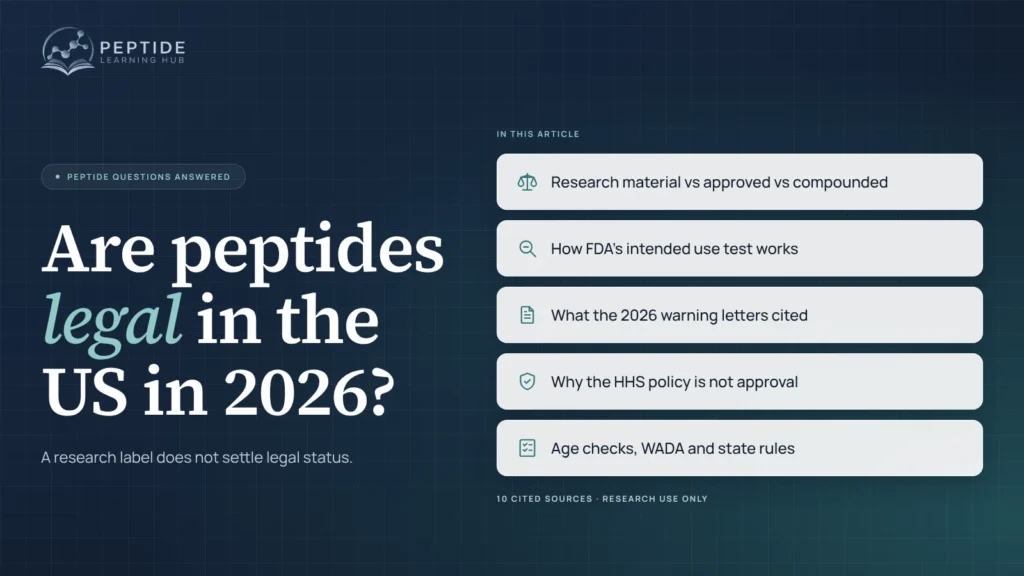
Research peptides can be sold in the US for laboratory research, but they are not approved drugs, and a “research use only” label does not settle their legal status. FDA judges a product by its intended use, taken from everything a seller says and does. This guide explains the 2026 picture. It is not legal advice.
This guide sets out how US rules treat research peptides in 2026: the difference between research material, approved drugs and compounded medicines, why FDA looked at whole websites in its 2026 warning letters, what the compounding decisions of 2026 did and did not change, and why suppliers ask buyers to confirm they are 21 or older. It sits in the research topics index under Peptide Questions Answered.
It is general information about published rules and agency actions, not legal advice. Rules change, and how they apply depends on the facts of each case. For a decision that matters, speak to a lawyer who works in FDA law.
Three categories that are easy to confuse
Most confusion about legality comes from treating three different things as one. A peptide’s status depends on which of these it is.
- Research use only material. Sold to laboratories for in vitro and other research work. It is not approved for any use in people or animals, and it is not sold as a drug, supplement or cosmetic.
- Approved prescription medicines. Peptide drugs that have been through FDA review, such as semaglutide, tirzepatide, tesamorelin and bremelanotide. They are made to approved standards and dispensed on prescription.
- Compounded medicines. Prepared by a licensed pharmacy or physician for a named patient on a prescription, under section 503A of the Federal Food, Drug, and Cosmetic Act, using bulk substances that meet set conditions.
The phrase “research use only” has a formal origin in device rules. Under 21 CFR 809.10, in vitro diagnostic products in the research phase carry a research use only statement. For chemical reagents such as peptides, the label signals the market the seller is aiming at. It is not a license and does not make a product legal on its own.
Research use only (RUO)
A label for material sold for laboratory research. It does not approve the material for any use in people or animals.
Intended use
What a product is objectively meant for, judged from labels, websites, claims and how it is sold.
503A compounding
Medicines prepared by a licensed pharmacy or physician for an individual patient on a prescription.
Enforcement discretion
A stated choice not to take action in set conditions. It is not approval and not a change in the law.
More plain-language definitions sit across the article library.
How FDA decides what a product really is
FDA does not stop at the label. Its intended use regulation, 21 CFR 201.128, was clarified in a 2021 final rule that took effect on September 1, 2021. It says intended use can be shown by any relevant source of evidence, direct or circumstantial, including how a product is labeled, advertised, designed and distributed.
That is why the website matters as much as the vial. A product labeled “research use only” can still be treated as an unapproved drug if the seller’s pages, product names, calculators, bundled supplies or customer messages point to use in people.
FDA applied this test in letters dated August 24, 2026, sent to five online peptide sellers. According to a published letter, the violations were found during a review of the seller’s website in July 2026, and the agency said the research and “not for human or veterinary use” statements on the labels did not change its conclusion. Law firm summaries of the letters note that FDA also treated bacteriostatic water sold alongside the peptides as a drug product. A warning letter reports FDA’s view of a specific seller. It is not a court ruling, and it does not show that any product was tested.
A research use only statement only means something when everything else about the sale matches it: research framing, no dosing or human-use content, and documentation such as a lot COA.
What changed for compounding in 2026
Several 2026 decisions concerned compounding pharmacies, not research suppliers. They are often reported as making peptides “legal”, which overstates them.
- April 2026. FDA announced on April 15 that 12 peptides would leave Category 2, its list of bulk substances that raise significant safety concerns, after their nominations were withdrawn. Removal took effect about April 22. Leaving Category 2 did not add them to the 503A bulks list or allow compounding.
- July 2026. On July 23 and 24, FDA’s Pharmacy Compounding Advisory Committee voted to recommend BPC-157, KPV, TB-500, MOTS-c, Epitalon and Semax for the 503A bulks list and voted against emideltide (DSIP). The votes are advice to FDA, not a decision, and FDA’s own reviewers had recommended against all seven.
- October 2026. HHS issued an interim enforcement discretion policy for the same six peptides, announced on October 28 and noticed in the Federal Register on October 30. HHS says it does not intend to act against state-licensed pharmacies, federal facilities or licensed physicians compounding them under 503A, if every condition in the policy is met.
None of these steps approved a drug, and none covers research use only material. The HHS policy itself says it is meant to discourage the use of research use only peptides from foreign manufacturers. Law firms reviewing it stress the same point: enforcement discretion is not legalization, and it does not bind state regulators.
Why suppliers ask buyers to confirm they are 21 or older
Many US research suppliers set 21 as a minimum age and ask buyers to complete a research attestation. This is supplier policy rather than a federal rule written for peptides. It supports the research framing of the sale, alongside account checks, research use only labels and terms that bar use in people or animals.
As an example, TLC Renew’s RUO Policy limits orders to buyers aged 21 or older and asks for a research-use acknowledgment at checkout, including the buyer’s research setting. Disclosure: the Peptide Learning Hub is operated in association with TLC Renew.
An attestation does not change a product’s legal status. It records how the material was sold and to whom, which matters because intended use is judged from the whole sale.
Sport and state rules
Two further layers sit on top of federal law.
- Anti-doping rules. The World Anti-Doping Agency’s S0 class covers substances with no current approval for human therapeutic use. The 2027 Prohibited List, in force from January 1, 2027, adds peptides as named examples and states that a peptide does not need to be listed by name to be prohibited.
- State boards and laws. States regulate pharmacies and prescribers, and they have moved in different directions. Ohio’s Board of Pharmacy advised in December 2025 that research-labeled medications are unlawful for prescriber clinics and medical spas to possess. Alabama’s medical board warned prescribers against research-grade peptides in mid-2026. Louisiana’s SB 253, effective August 1, 2026, bars its licensing boards from preventing licensed prescribers from providing peptides sourced from a compliant pharmacy.
How to check a peptide’s status yourself
Statuses change, so check primary sources rather than seller summaries. These are the main ones.
- Drugs@FDA, for whether a peptide is an approved drug and under what name
- FDA’s 503A bulk drug substance categories, for compounding status
- The HHS peptide enforcement discretion policy and its appendices, for the six covered peptides
- FDA’s warning letter database, for enforcement against named sellers
- The current WADA Prohibited List, for sport
- Your state board of pharmacy and medical board, for state rules
Whatever the status, a research supplier’s paperwork should match its research framing. Matching a vial to its lot certificate is covered in lot numbers explained, and how we decide what a source can support is set out in how we write.
- Research use only material, approved drugs and compounded medicines are three different things
- FDA judges intended use from the whole sale, not the label alone
- The 2026 compounding steps covered licensed pharmacies, not research material
- Advisory votes and enforcement discretion are not FDA approval
- WADA and state rules add further limits; this guide is not legal advice
Frequently asked questions
Research peptides can be sold and bought for laboratory research, but they are not approved drugs. A research use only label does not make a sale lawful by itself, because FDA looks at the intended use shown by the whole sale. Rules also vary by state. This is general information, not legal advice.
A prescription peptide is an FDA-approved drug, made to approved standards and dispensed on prescription. A research peptide is laboratory material that has not been through drug approval and is not intended for people or animals. A compounded peptide is a third category, prepared by a licensed pharmacy for a named patient.
Yes. Several peptide medicines are FDA approved, including semaglutide, tirzepatide, tesamorelin, bremelanotide and insulin products. Approval covers the specific approved product, made by its approved manufacturer. It does not extend to research material sold under the same compound name, which has not been through that review.
It is a statement of how the seller says the product is meant to be used. It does not grant legal protection on its own. Under FDA’s intended use regulation, the agency can weigh the label against everything else the seller says and does, and in 2026 it treated labeled products as unapproved drugs.
FDA said the sellers were marketing unapproved new drugs for human use. In the August 24, 2026 letters, it based that view on website reviews carried out in July and said research use only statements on labels did not outweigh the website evidence. The letters set out FDA’s position; they are not court rulings.
No. The HHS policy says it does not intend to take action against licensed pharmacies and physicians compounding six named peptides for patients, if every condition is met. It is interim, does not approve any drug, does not bind states and does not cover research use only material.
It is supplier policy rather than a federal rule written for peptides. Suppliers pair the age check with a research attestation to show the material is sold to adult buyers for laboratory work. The check records how a sale was made; it does not change the legal status of the product itself.
Generally not in tested sport. WADA’s S0 class covers substances with no current approval for human therapeutic use, and the 2027 Prohibited List, in force from January 1, 2027, adds peptides as named examples. It also states that a peptide need not be named to be prohibited. Athletes should check with their anti-doping organization.
Yes. States regulate pharmacies and prescribers and have taken different positions. Ohio and Alabama issued guidance warning against research-labeled peptides in clinical settings, while Louisiana’s SB 253, effective August 1, 2026, protects prescribers using peptides from compliant pharmacies. Check your own state board of pharmacy and medical board.
Use primary sources. Drugs@FDA shows approved drugs. FDA’s 503A bulk drug substance categories show compounding status. The HHS enforcement discretion policy lists the six peptides it covers, and FDA’s warning letter database shows enforcement. Check the date on each source, because statuses changed several times in 2026.
Sourcing reference material for in vitro work? TLC Renew, the supplier associated with the Peptide Learning Hub, sets out its research use only terms in its RUO Policy and has a COA lookup that searches by the lot number on the vial.
Read the RUO Policy
Check a lot COA
Research use only. Not for human or veterinary use.
Get the full regulation file
Members get the longer regulation files, with the 2026 timeline in table form, links to each primary document and research summaries.
- ✓Full VIP video and document library
- ✓COAs, research summaries and guides
- ✓New content added regularly
- ✓Approval-based members area
- US Food and Drug Administration, 2021. Regulations Regarding “Intended Uses”, final rule amending 21 CFR 201.128 and 801.4. Federal Register 86, 41383. Source
- US Code of Federal Regulations. 21 CFR 809.10, Labeling for in vitro diagnostic products. Source
- US Food and Drug Administration, 2026. Warning Letter, TXP Innovations LLC dba Tex Peptides, reference 735067, August 24, 2026. Source
- US Food and Drug Administration. Bulk Drug Substances Nominated for Use in Compounding Under Section 503A of the FD&C Act (Categories 1, 2 and 3). Source
- US Department of Health and Human Services, 2026. Enforcement Discretion Policy Regarding 503A Compounding Using Certain Peptide Bulk Drug Substances; notice of availability. Federal Register 91, 68526, FR Doc. 2026-22192. Source
- US Department of Health and Human Services, 2026. HHS Enforcement Discretion Policy Regarding 503A Compounding Using Certain Peptide Bulk Drug Substances (policy text and appendices). Source
- McDermott, 2026. Client alert: Bulk-list bound? PCAC backs majority of peptides in two-day public meeting (July 27, 2026). Source
- McDermott, 2026. Client alert: Federal regulators and state boards crack down on RUO peptides (September 24, 2026). Source
- Sport Integrity Commission New Zealand. The Prohibited List, including 2027 changes. Source
- American Med Spa Association, 2026. New Louisiana Peptide Protections (SB 253). Source
- 17 Nov 2026: First published. Regulatory status checked against the sources above in November 2026.
For research and educational purposes only. Nothing here is medical, legal or regulatory advice, and compounds discussed are not approved for human or veterinary use unless stated. Compounds discussed are for Research Use Only: not for human or veterinary use, not for diagnostic use, and not for use as a food, dietary supplement or cosmetic. The Peptide Learning Hub is operated in association with TLC Renew, a supplier of research use only reference material, and links to TLC Renew are there because of that relationship.
